 The Art of eComm
The
Last Retention Playbook You'll Ever Need
The complete post-purchase retention system turning first-time buyers into loyal subscribers paying you more, and for longer.
The collection
The Strategies Trusted By:
The same retention work runs underneath every brand here.
Introduction
Why The Post-Purchase Experience Decides Everything
Most brands lose the customer in the two weeks right after the sale, and don't even notice it.
Everyone is always so focused on getting the customer through the door with a beautiful ad/creative, that they stop caring what happens after they actually purchase.
Meanwhile, that customer is sitting there wondering if they just wasted their money on a product they have no clue how to use. And by the time the renewal hits, they've forgotten they were even subscribed, so it just feels like they got scammed out of their money!
We don't want to be doing that!
And to prove it to you with pure numbers, here's the LTV of an anonymous brand, with proper post-purchase communications set up vs without them:
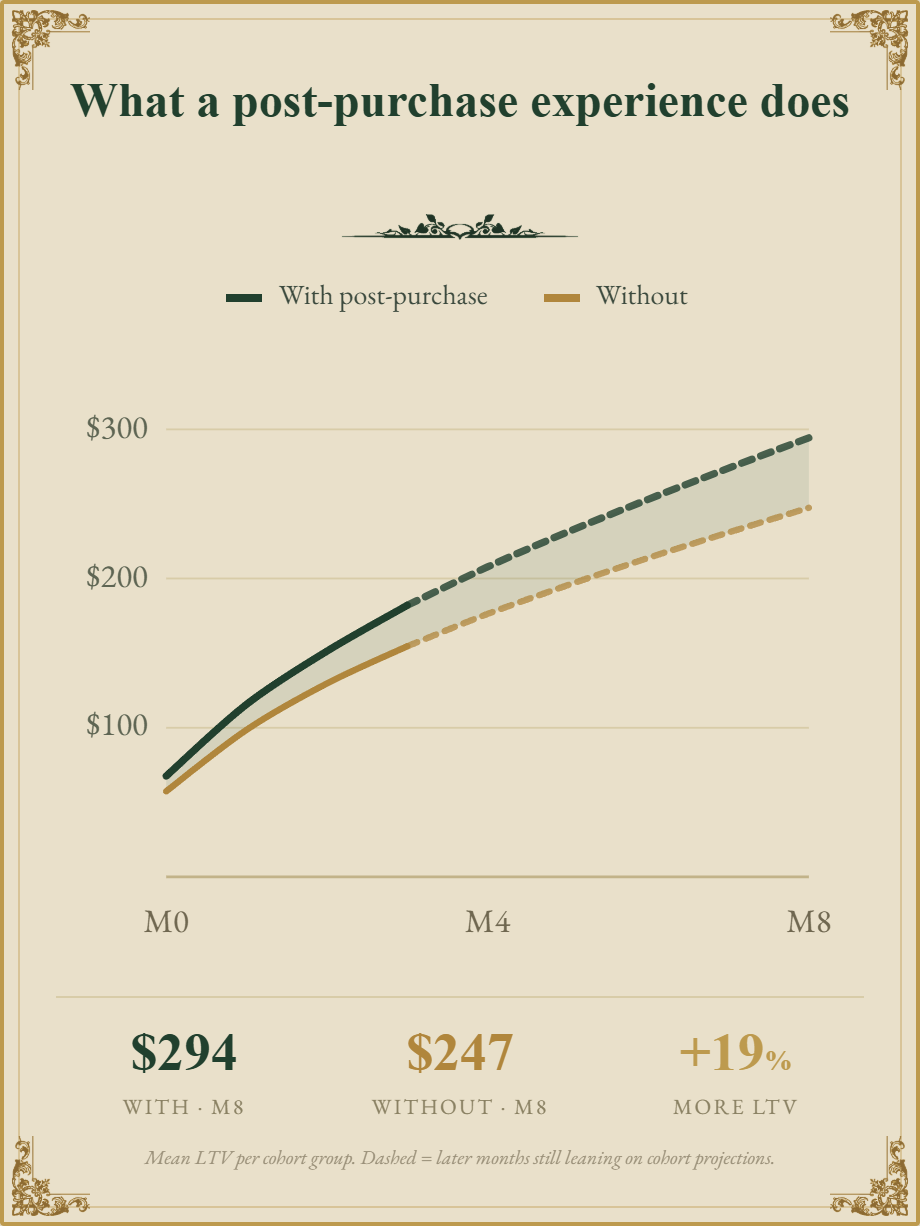
A whole +$47 difference in Lifetime Value per CUSTOMER!!!!
Meaning that if this brand has for example, 20,000 new customers coming in every single month, this translates to an additional $47 * 20,000 = $940,000 added in pure profit, straight into the business' pockets. (and that's just for ONE month)
And please remember: you're not spending an extra penny to acquire these customers. They're just buying more products from you, for a longer period of time.
Retention has become a buzz-word everywhere, but nobody actually knows what strings to pull to make the magic LTV & Customer Retention numbers go up.
Not to worry! This is exactly why I created this Playbook.
The Last Retention Playbook You'll Ever Need!
In the pages you're about to read, I explain everything you need to know, whether it's about the real metrics you need to be looking at, the kind of buyers you want to attract, how to minimize billing reminder churn & real, proven strategies for setting up your post-purchase communications…
Whatever it is, I've got you covered! I've helped multiple 8-9 figure eCommerce brands recover millions of dollars in ARR, so it's fair to say I know a thing or two about this!
Plus, I took the time to write the whole Playbook by hand (or fingers rather, I'm typing), in a world that's filled to the brim with AI slop, so I really hope you find it valuable!
Part one of three
Strategy
When I was putting this Playbook together, I figured we'd start with the big-picture strategy, the stuff that sets your brand up to pull the most recurring revenue out of your customers.
Specifically, there's 2 things to look out for in this section:
- The Single Biggest Lever For Recurring Revenue
- The Most Important Metric You Should be Looking at
Let's get into it:
Strategy · the biggest lever
Subscription VS One-Time Purchase
Did you know that a one-time buyer spends on average 2.4x LESS than the average subscriber?
I know, it's insane.
And no, I'm not pulling the numbers out of thin air.
I came up with this number after pulling up the averages across dozens of Shopify brands.
If you want, you can check the difference between a subscriber and a non-subscriber's LTV by going into your Shopify Dashboard, and then clicking Analytics → Customer Cohort Analysis → Amount Spent Per Customer → First Order Has Subscription → Toggle Yes and No.
Here's the numbers from a real, anonymous Shopify brand:
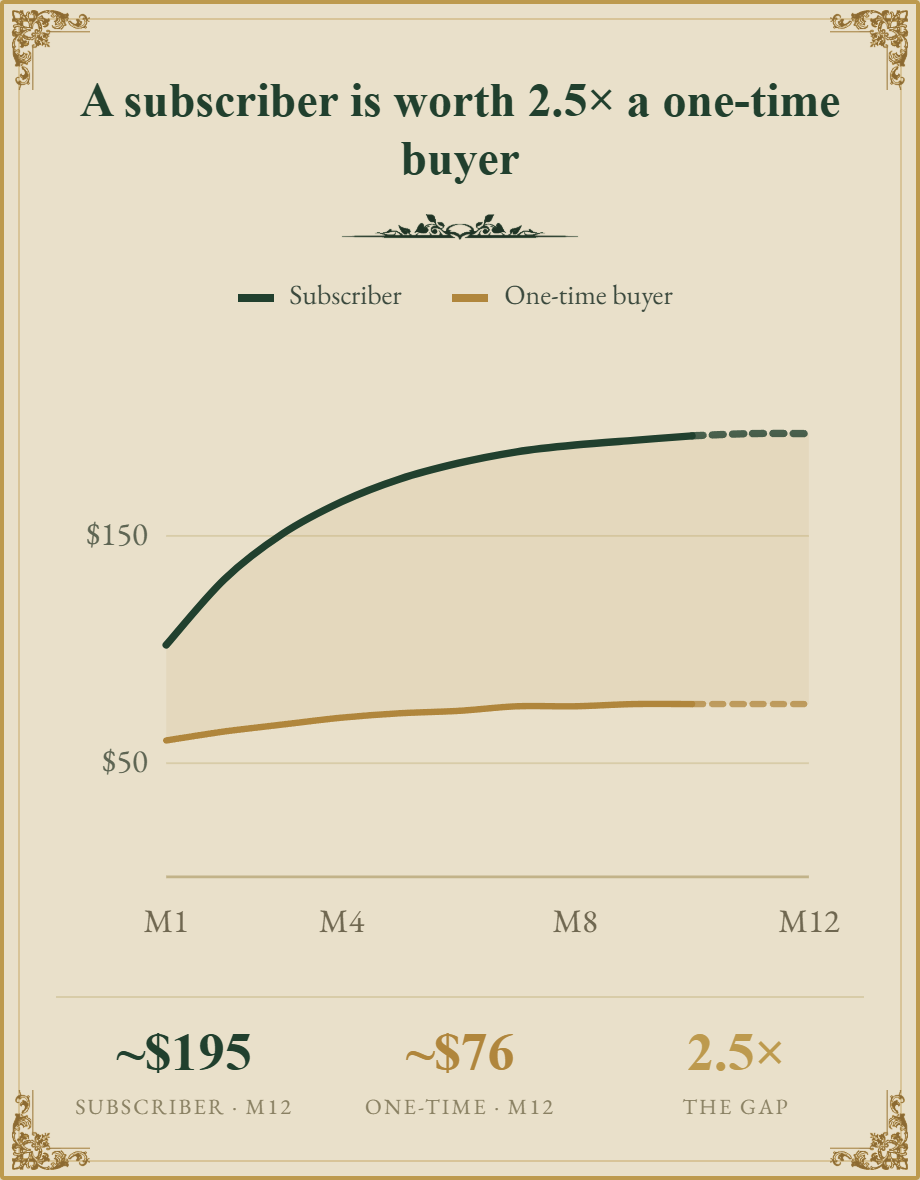
A $119 LTV difference!!!
And while most customers that opt in for a subscription on their own are more likely to have higher LTV numbers, that doesn't mean that you should be limiting your one-time buyers to a low lifetime value.
The very same one-time buyer becomes worth multiples more the moment that they subscribe.
Once we got that out of the way, there's 2 ways to get your one-time buyers to become a little bit more productive:
1. Go Full Subscription
Completely disable the one-time purchase button, and only allow customers to buy from you through a subscription.
While it's not illegal to only be selling products through subscription, you need to let your customers know that they're going to be subscribed, so that they remember to cancel if they really don't want to get that refill.
This is a very effective way to get the most LTV possible out of your customers, at the cost of giving your customers less freedom.
If you're not transparent about the fact that the customers are in a subscription on the website or in the post-purchase communications the number of support tickets and refunds is going to climb.
2. Create a series of flows that turns one-time buyers to subscribers.
This is a less radical and more common choice than the previous one.
All you need to do is to create a post-purchase experience for one-time buyers, where you invite them to start their subscription, now that they've become familiar with the product.
It tends to be less effective in boosting LTV than going full subscription, but is still a sure-fire way for boosting retention naturally.
My honest advice: There's no definitive best way to go about this. I have seen both work extremely well, since a lot of it comes down to your brand's structure, culture and model.
Let's move on to your LTV:CAC Ratio Calculator!
Strategy · the metric that matters
The LTV:CAC Ratio
If you have spent years inside ad accounts, ROAS feels like the truth.
Return On Ad Spend.
How much more clear can this metric be?
Well, while it's the single best metric for measuring an ad's performance, in reality, it's not the whole truth.
All ROAS does is measure the revenue an ad brought in against what you spent on it.
It is blind to everything that happens after that first purchase. For example:
- A 2X ROAS on a customer who never comes back is a slow loss.
- A 1.5X ROAS on a customer who reorders for two years is a goldmine.
ROAS cannot tell those two apart. This is where the LTV:CAC ratio comes in, because it can weigh the entire lifetime of the customer against the full cost of winning them.
LTV : CAC ratio = lifetime value of a customer ÷ cost to acquire them
So I created this LTV:CAC ratio Calculator, where I explain what your current ratio means for your brand's health.
(If you're curious like me, you can draw along the slider to see how the ratio behaves as it increases or decreases!)
Sweet spot: 3.5 to 4 · per Thomas Lalas, Retention Economics
Wherever you land below the sweet spot, the lever is the same: a higher-performing post-purchase experience lifts your LTV, pushes this number up, and lets you take share while competitors stall.
Part two of three
The 3 Principles
Congrats! You've completed the first chapter of the playbook!
Now that you've got strategy under your belt, let's get into The 3 Principles that constitute a proper post-purchase subscriber experience!
Transparency, Personalization, and Education.
(Note: every asset in the post-purchase experience breakdown in the 3rd chapter, is based on these 3 principles, so read carefully!)
Principle one of three
Transparency
Before I explain why it's crucial to be transparent with subscribers in your post-purchase communications, let's first ask a very important question:
"Who are the post-purchase communications targeting?"
"The subscribers of course!"
Duh! But what kind of subscribers do we have? It's very important to separate them, otherwise we don't know who or what we're dealing with here.
I like to separate them into the following 3 segments:
- The subscribers who will become loyalists no matter what we do
- The subscribers who will cancel after the first month no matter what we do
- …And the subscribers who are right in the middle and can be swayed either way, depending on our marketing material and communications
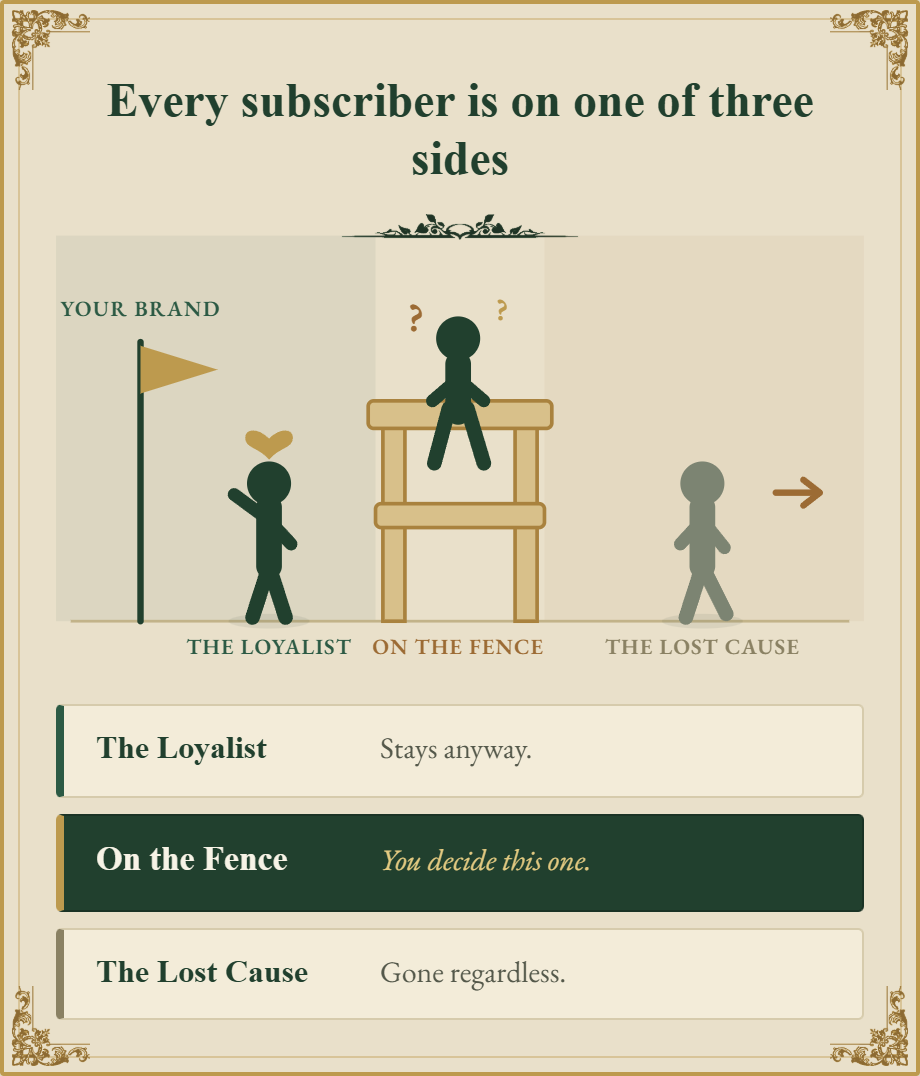
(The above 3 types of subscribers exist in all eComm brands, but the percentage of how many subscribers act as loyalists or as churn-machines varies according to the brand's niche. For example, Pet Food brands tend to have extremely high retention, with many loyalists, whereas on the other end we find Beauty brands, with most customers cancelling their subscription after 2-3 months.)
It's fair to say that it would be completely pointless to try and keep a CPG subscriber who doesn't like the product's taste and doesn't even use it.
So we won't try to keep them.
The point of the post-purchase experience is to
- Influence & retain the people that lay right ON the fence.
- Identify the loyalists, reward them and try and push for more LTV upfront (more on that in the later chapters)
Once we get that out of the way, everything becomes so much more clear, because we realize that we don't have to lie to our customers in order to retain them.
We don't have to trick them by not sending them billing reminders, and hiding the fact that they're in a subscription. Going down that route won't get you anywhere long-term, because yeah, you might get all time low churn for the first month, but that's only going to result in:
- More customer support tickets from people asking for their money back
- Customers losing their trust in your brand, leaving 1-star reviews on TrustPilot
- Record-high cancellations for Month 2, Month 3 and beyond.
It is very difficult to retain someone past the second or third month when your whole model is based on tricking them into renewing.
This is exactly why I like to say that for eCommerce brands, the subscription is something you have to earn from the customer, not something that you force them into without their consent.
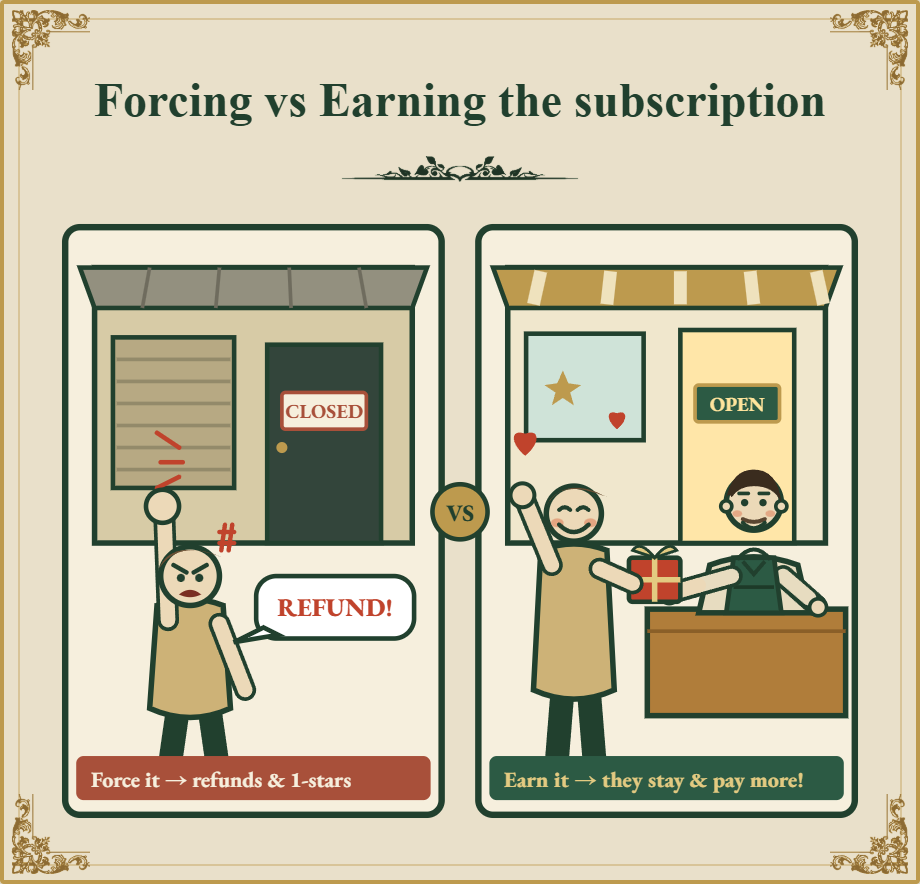
As a result, we need to be as transparent as possible in our post-purchase communications. We need to let customers know that they're subscribed to their product, and make it absolutely clear that they didn't perform a one-time purchase.
This automatically results in better Retention & LTV Numbers down the line, as well as higher customer satisfaction. People start feeling that they actually belong in your brand the more open and communicative you are with them, and they tend to stay around for longer that way.
Now, you know that transparency is 1 out of 3 communication principles that are necessary for a proper post-purchase experience.
What are the other 2 I hear you ask?
Principle two of three
Personalization
Similar to how we theoretically separate subscribers into loyalists, on the fence, and as dissatisfied ones, according to each brand, people might have different reasons for buying your product.
For example, for a functional coffee alternative supplement, there could be people buying:
- Because they want to quit regular coffee
- Because it helps them with their gut health
- Because they want to see the mental benefits that occur from nootropic mushrooms
And that's just to name a few. There's definitely more.
So how can you be sending the same exact communications to all of these people that have bought your product for all of these different reasons?
If you don't personalize your messaging, you're just screaming at the subscriber, you're not talking to them like a normal human being would.
Picture that subscriber trying to have a conversation with an actual representative from a brand:
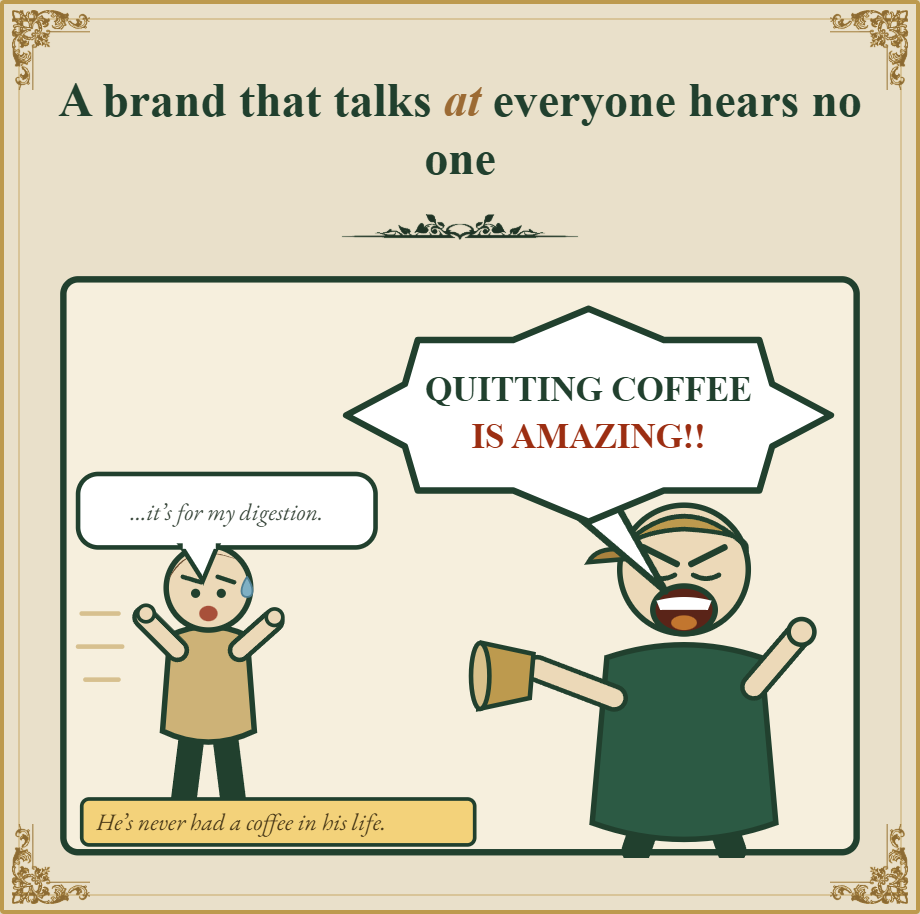
"Hey, love your product! I'm using it because it helps me digest so much better! I couldn't live without-"
"YEAH I KNOW RIGHT? QUITTING COFFEE IS AMAZING. THIS IS WHY WE STARTED OUR BRAND IN THE FIRST PLACE!!"
"I haven't drank coffee in over 10 years, what are you talking about?"
"QUITTING CAFFEINE IS SO DIFFICULT. TELL US ABOUT IT."
"Are you even listening to what I'm saying?"
This is how most customers feel if they receive communications that are not adapted to their wants and needs. Just feels like someone shouting at them, when all they want is to have a conversation, to feel understood.
Similar problems may appear if brands have the same post-purchase experience across different subscription products.
Coming back to the coffee alternative example, if the same brand has a product that's caffeine free, chances are that customers are using it to relax and wind down in the evening.
If the same brand has another product that has caffeine inside it, customers would be using it to wake up in the morning, and stay energized after their lunch.
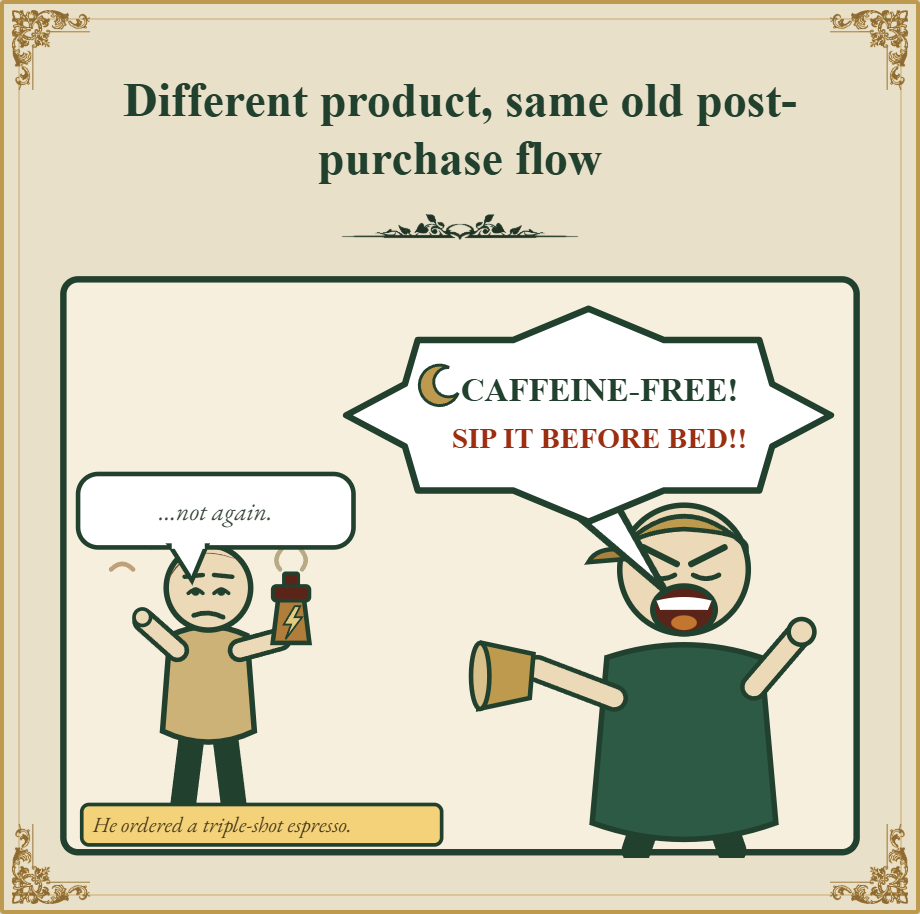
There's a huge disconnect between one audience and the other. We CANNOT be sending the same post-purchase experience to both of them. If we don't personalize the experience, it's like going out to practice your archery with a blind-fold on.
You're shooting completely blind, and are praying that one of your shots lands by accident. It's not viable, and it's definitely not going to get your Retention & LTV numbers looking better.
To personalize our Post-Purchase communications, we use various surveys and check-ins, where the experience gets automatically personalized according to the user's preferences. We'll get more into that in the later chapters, for the time being let's get into the 3rd Communication Principle:
Principle three of three
Education
Education! Where would we all be without it?
I read somewhere the other day that if humans don't learn how to speak until they're 10, their brain fails to develop properly and they can never become members of society.
Similarly, how do you expect your subscribers to become members of your brand if you don't educate them on how to use your product properly, or what benefits to expect?
It's a perpetual cycle. If the customers don't use the product properly, they don't get the results they're looking for, they don't feel satisfied, and from the moment they don't feel satisfied, they won't use the product, and so on.
The end result of this cycle is the fact that your customer is probably going to cancel their subscription.
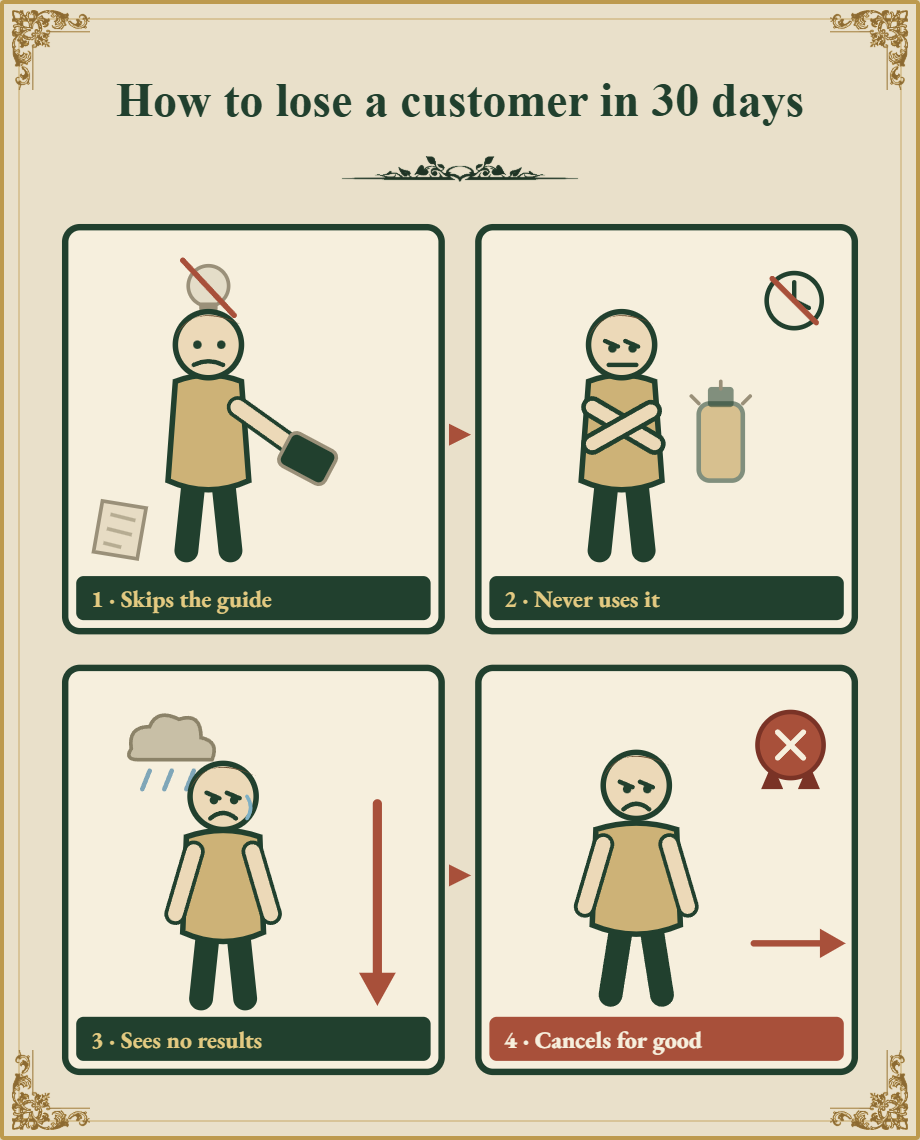
The good thing is that this perpetual cycle can also work in your favour if you use it wisely.
And when I say wisely, I don't mean just shoving a 10-page PDF with instructions and facts about the product down their throats!
Seriously, is even 1 person going to read that thing, in an age where attention spans have been reduced to ash?
Everyone is looking for a quick win. Everyone is looking for that instant gratification, for that dopamine hit. People are reading fewer and fewer books than ever before! And that's for subjects that are really interesting to them.
How are they going to read a 10-page PDF about a product that they just bought?
In order to adapt to the modern "butterfly attention spans", at The Art of eComm we use Bite-Sized Premium Masterclasses.
1-2 minute FUN, entertaining classes on how your product works, where we also include habit formation tips, and a structured out timeline of benefits of the product, to set expectations.
This way, the customer:
- Gets multiple quick wins (aka dopamine hits)
- Learns how to use the product properly
- Uses the product more (so they don't cancel because they have "too much" of it)
- Sees more results & benefits because of proper usage.
- Is more likely to stay subscribed!
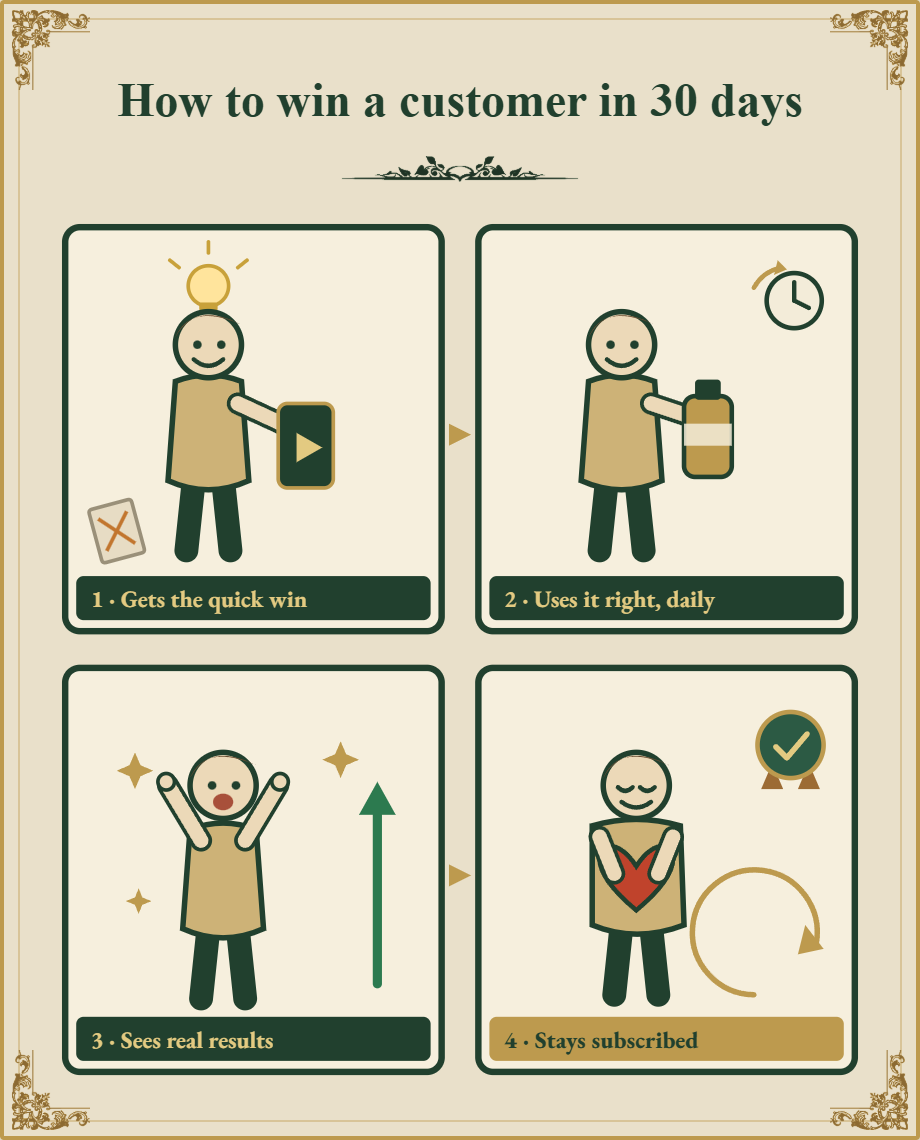
There's the positive cycle I was speaking about!
Congratulations! Now you know everything about the 3 Communication Principles that constitute a proper Post-Purchase Experience! Transparency, Personalization & Education!
Now, it's time to learn how to put these principles into practice, and get your Retention & LTV numbers looking healthier than ever!
Part three of three
The Post-Purchase Experience
Now that we're on the same page in regards to the overall strategy and the principles that constitute an efficient & retention-friendly post-purchase experience, let's look into its 3 distinct stages, and its components in more detail.
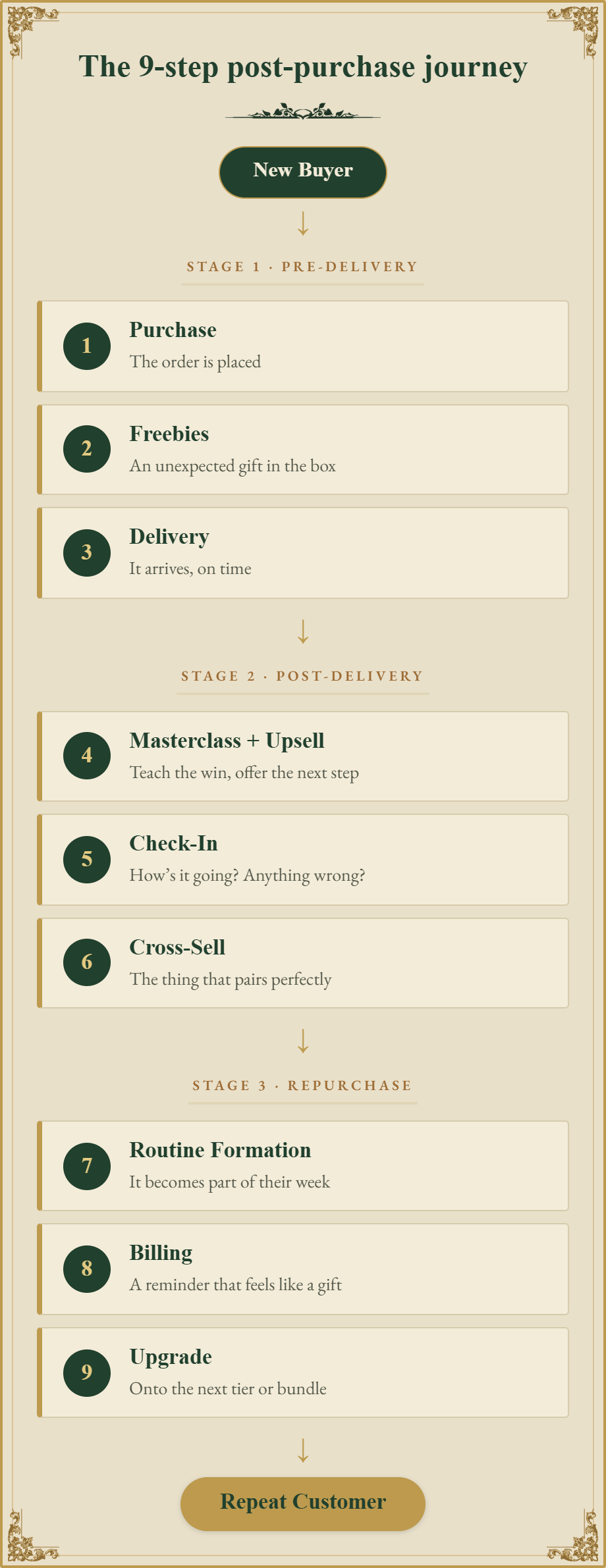
Missing either one of the above stages of the post-purchase experience, is going to be a missed opportunity in terms of tapping into the customer's LTV potential.
So pay attention!
The post-purchase experience · the warm-up
Freebie Strategy And Positioning
Free gifts!
Is there something else in the world that we love more as human beings?
Actually, yeah, there's the feeling of loving and being loved by a person close to you…
But is it possible for a brand that's doing many millions of dollars per month to show that love to each one of its 1,000s of customers? No…
So sending out a gift serves as the next best alternative.
Jokes aside, including gifts into your subscriber's journey is one of the best ways to boost LTV & Retention naturally. Loyalty programs are literal gold mines.
It's the fastest way to kill buyer's remorse by over-delivering before the product even arrives.
By being generous and including a gift inside of the first order, the buyer's brain quietly concludes it made a good decision.
A perk the buyer did not expect has more of an impact on the buyer than the perk that they bought.
It signals that the brand gives more than it takes, and that signal is worth more than the freebie itself.
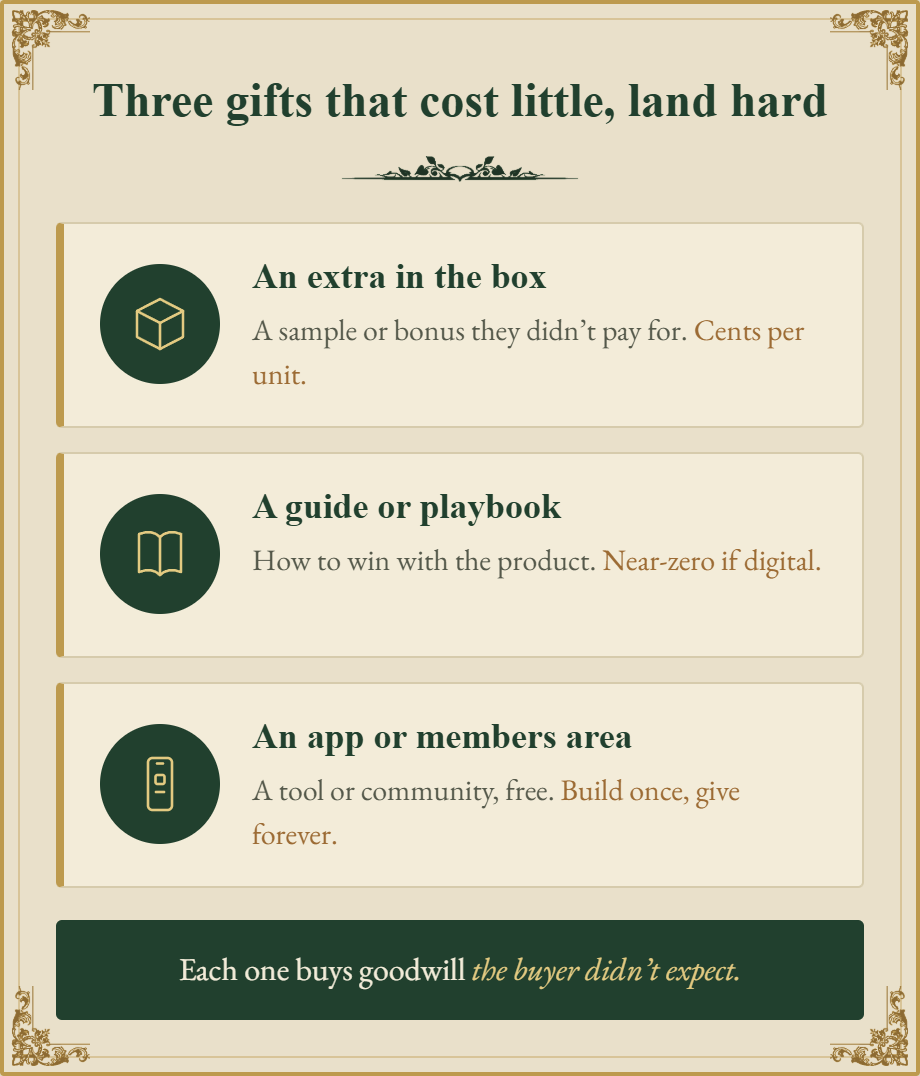
However, not all freebies are good freebies. Some might cost you too much to produce, while not being of immediate value to the customer.
The general rule of thumb is to make sure that your free gifts:
- Cost little to nothing to produce (ebook, free app)
- Are practical, and something that the subscriber would use anyway (a frother for a beverage brand, a travel can for a nicotine pouch brand, a workout app for a gym supplement)
- Are spaced out across the first 3 months of the experience, since that's when churn is at its highest. (After month 4 it slows down, so there's automatically less leverage in having a free gift later on)
Also important: To make the most out of your freebies, you need to make sure that they're visible to the customer the whole time that they're interacting with the brand.
The freebies need to be visible the moment that the subscriber purchases on the website, they need to be visible on the subscription portal, so that they serve as milestones, and they also need to be visible throughout the post-purchase communications, over the months.
A freebie could also be a sample of another product that the subscriber hasn't bought yet, so that we give them a taste, and later give them the choice of adding it to their subscription full-time, not just as a one-time thing.
(Once again, a lot of it depends on the SKUs your brand has, the type of products it sells, and the stock available at hand, so I cannot be too specific about your brand's freebies simply because I don't have the full picture!)
Now that you know how to set up your brand's loyalty program for maximum Retention & LTV, let's get into the stages & components of the post-purchase experience.
Stage one, Pre-Delivery
Pre-Delivery
The goal of this stage is to alleviate any purchase regrets, provide transparency on the order's progress, and give a lot of upfront value.
It front-loads the buyer, almost overwhelmingly, with announced and unannounced freebies, order updates, and quick notes from the founder.
Unlike most brands that just go quiet after the purchase happens, it's important that we are transparent, since most customer churn happens 2 weeks after the customer's initial purchase.
It also acquires zero party data from the buyer, so we can personalise their experience in the Post-Delivery & Re-Purchase stages.
(All of the components I'm going to be mentioning below are usually built on an ESP, mainly Klaviyo, and in some cases partnered with SMS for getting more engagement on messages with a direct CTA)
Here's how we do that practically:
Pre-Delivery, asset one · Personalization
Transactional Emails
When I say transactional emails, I mean that they're going to be received by everyone. They bypass the normal Spam/Promotional email filtering and land straight into your customer's main inbox.
I recommend using Wonderment/Loop Returns for setting up your transactional emails, because it always provides 100% accurate status updates on your customer's order. Shopify needs to depend on your carrier to make these status updates, which means that the data doesn't always pass through.
An order could already be on your customer's doorstep, but it's not guaranteed that Shopify will track the delivery. Wonderment always will, and it's crucial to make sure that all of the customers get the emails delivered at the time that they're scheduled to be sent out.
The reason for this is because the transactional messages get sent out during the customer's emotional peaks.
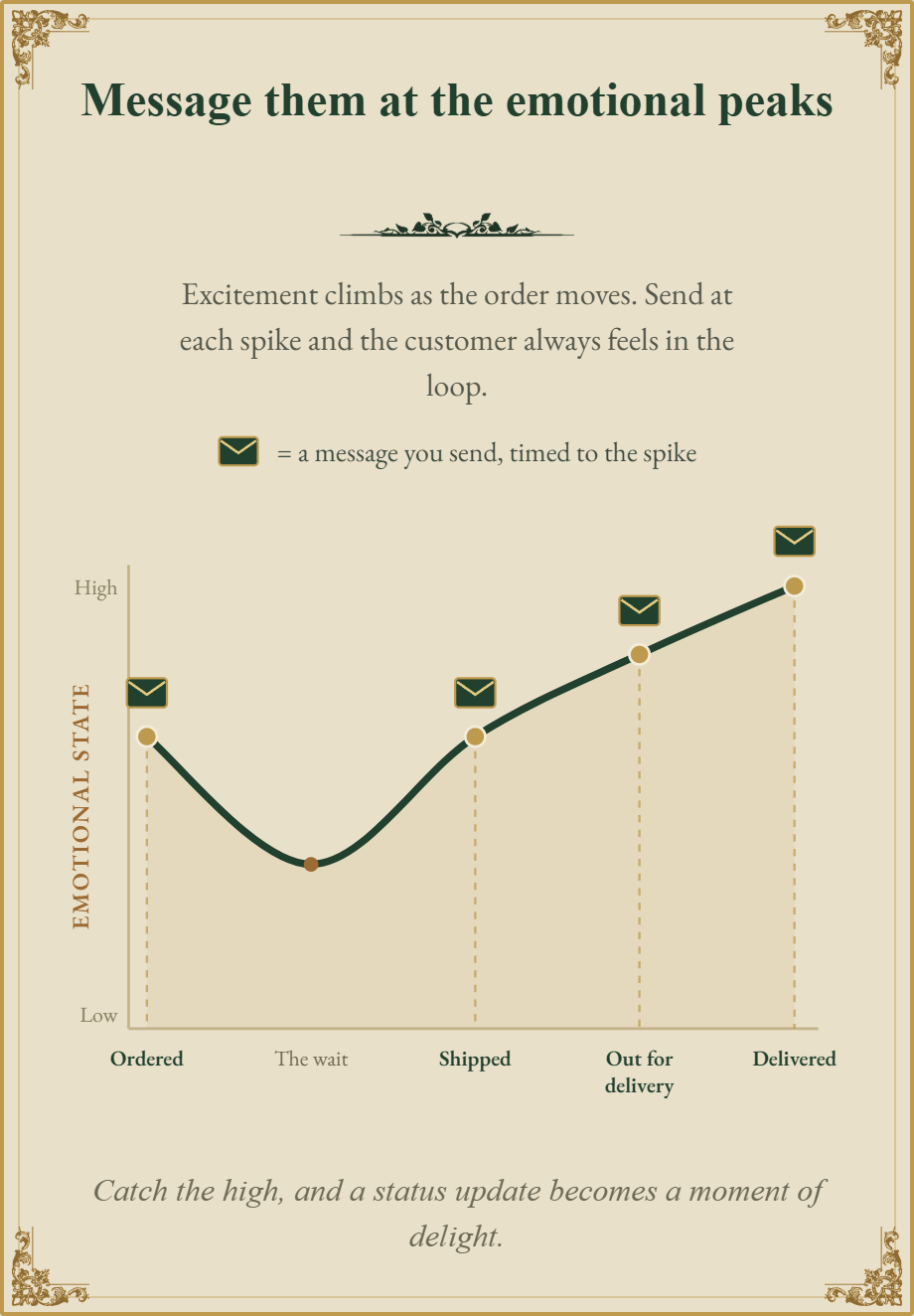
A message that lands while excitement is high gets read, felt, and remembered, instead of vanishing into a dead inbox.
Used that way, a status update does three jobs at once.
- We include a link to the tracking page, so it reassures the buyer the order is real and moving, killing buyer's remorse
- It carries your brand's voice at the exact moment they are paying attention.
- …And it pulls them toward the next step, the community, the education, the rest of your world.
Pro Tip: In these Transactional Messages, I like to include invites to the brand's Facebook Community, to cross-pollinate on multiple platforms with the brand's content, as well as get them to become a proper member of the brand. Creating a sense of community & cultiness is one of the best retention levers to pull.
If your brand doesn't have a Facebook Community, I recommend that you start one ASAP!
I usually send the following Transactional messages: (It's the same ones as on the graphic above):
- Order Confirmed
- Order Shipped
- Order Out For Delivery
- Order Delivered
They're all sent out at the highest emotional peaks. At the same time we're also personalizing the post-purchase experience, and being transparent about the order's status.
See how The 3 Principles are being applied in action? Plenty more of that to come in the next stages & components.
Pre-Delivery, asset two · Personalization
The Post-Purchase Survey
Immediately after the customer's order comes through, in our systems we send out an email & SMS asking customers to complete a short survey, hosted on Typeform that can easily be connected to Klaviyo, or your ESP of choice.
It is the key that unlocks the personalization principle at scale.
As I mentioned earlier, there's customers that purchase for entirely different reasons. Keep in mind the coffee alternative example, where customers buy to quit coffee, because it helps with their digestion, or because they want to get the benefits from nootropic mushrooms.
Inside of the survey, we ask them the reason for their purchase, while asking them to choose from the 4 biggest reasons.
From that point onwards, all of the resources that are going to be sent, are going to be personalized according to the reason the customer bought.
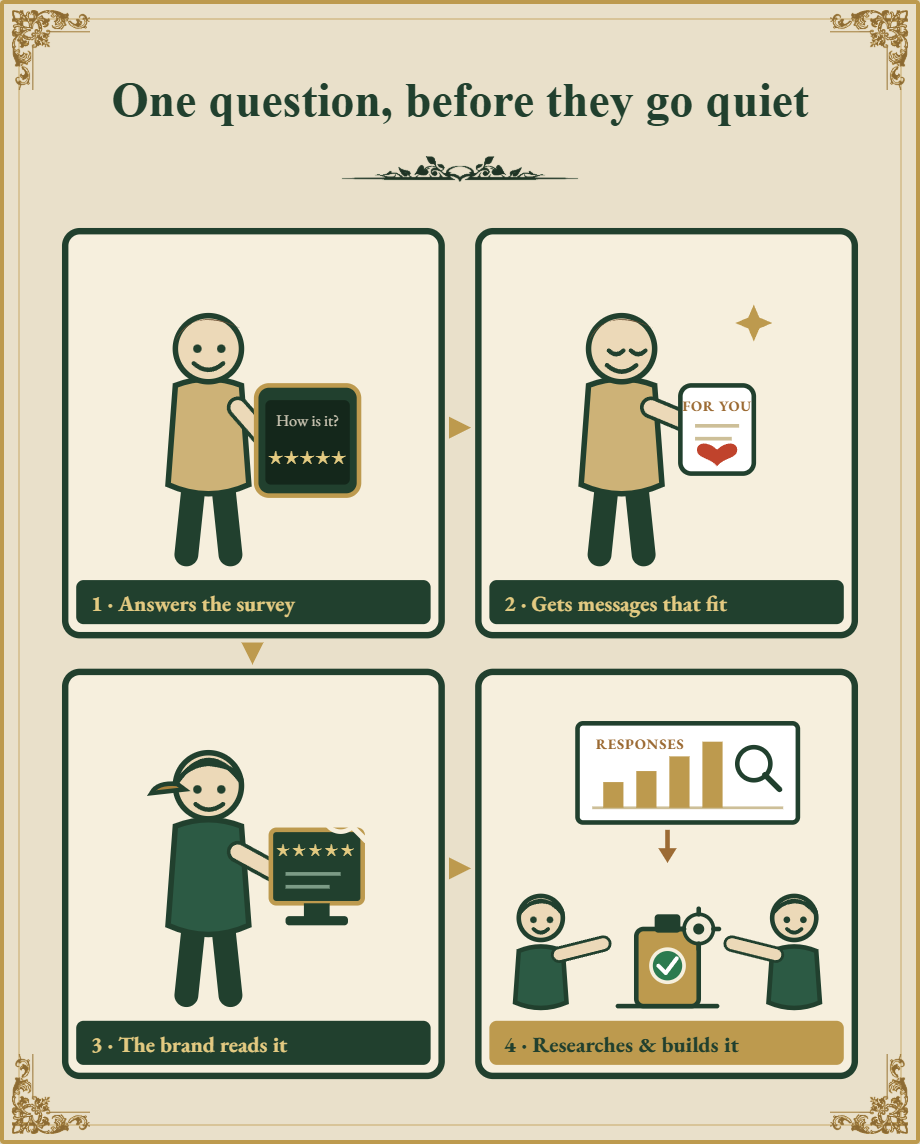
More personalization results in more connection with the customer, upsells that are more fitting, and education that best serves the customer's goals.
But the survey also works in 2 directions at once:
Pointed at the customer, as I just explained, it gives us the chance to automatically personalize the post-purchase communications.
Pointed at the brand (us) it serves as the cleanest market research you will ever run.
You can ask the customers what were their biggest objections that almost stopped them from buying in the front-end, so that you can create higher performing ad campaigns, you can ask them what other products they'd be willing to buy from you so that you can find the best product market fit and create new SKUs, or even identify potential loyalists & skeptics.
It serves as a Zero-Party Data goldmine, and sets you up perfectly for the next 2 stages of the experience.
Stage two, Post-Delivery
Post-Delivery
Now, after the customer has the product on their hands, it's once again, time to stand up and speak! We're still in the first 14 days of the experience, and the customer just got the product in their hands.
We must show them how to use it properly, so that we can leverage the perpetual cycle that we spoke about earlier. (Educate → Use more product → See better results → Stay subscribed)
The way we do this is by creating short, bite-sized premium masterclasses for the customers.
Post-Delivery, asset one · Education
Masterclasses
Similar to the Post-Purchase Survey, we also host these on Typeform. The simpler your stack is, the easier it is to track everything that's happening inside your business.
Here's how you can practically structure them, so that you give your customers a quick, fun way to learn more about how to use the product and win them over!
In Masterclasses particularly, you can leverage the Post-Purchase Survey by creating different Masterclass variations, depending on the reason a customer bought your product. More personalization = higher completion rates.
- Send your Masterclass series immediately after the product arrives, so that we educate the user how to use the product as soon as possible after it lands on their doorstep.
- Structure it as a series of 3-4 interconnected lessons that build upon each other while remaining valuable on their own. This way, a buyer who only engages with one BPM still gains useful insights, but those who complete the full series experience a deeper transformation and stronger brand connection.
- At the end of the masterclass, include an upsell where you upsell them to more of the same product so that they can supercharge their results, or if the product doesn't allow it, (specific dosage requirements) you cross-sell them to another SKU.
We have had instances where these upsells convert at over 53%, they're literal goldmines.
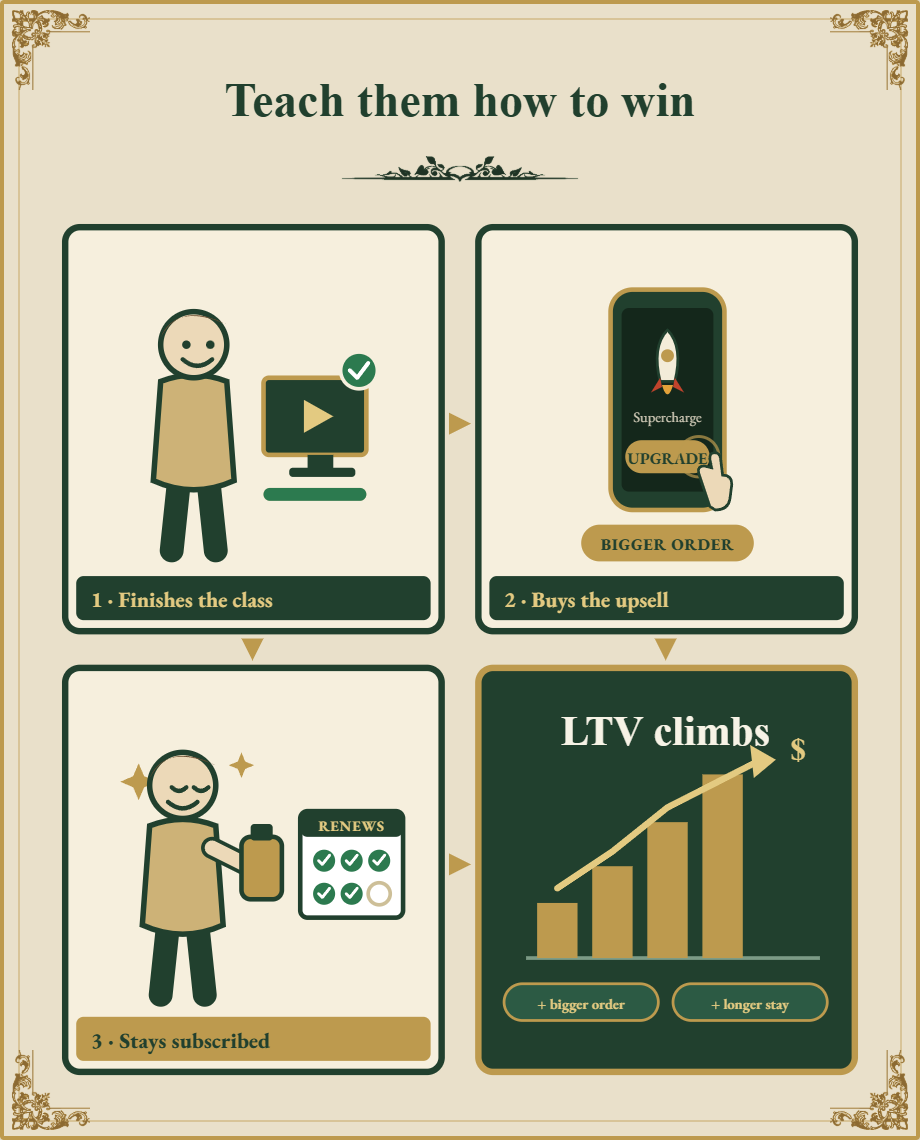
Some Pro Tips for creating the best possible Masterclasses:
- If it feels like a chore, they'll tune you out. Use interesting visuals to stimulate the reader in each slide, and forget long walls of text, use bullet points and emojis instead!
- No CTAs before the Upsell/Cross-Sell Slide. Don't use external links that move the reader away from the masterclass. The only CTA in each slide should be the 'next' button.
- Optimise each BPM for completion. Check your analytics to understand where your audience drops off. Use this data to refine your content and optimize future sessions for even better results. Because low completion means low upsell CTA visibility.
- Use BPMs to naturally introduce complementary products or upcoming freebies. How you implement this practically depends on your brand's SKUs, and the freebies you have decided to include in your loyalty program.
In conclusion, Masterclasses boost LTV with 2 levers:
- Direct LTV Boost through the Upsell
- Indirect LTV Boost, because better education results in higher Retention.
They buy more, and they stay for longer. It's a win-win situation.
Now that you know how to educate your customers in action, let's move on to the next component of Post-Delivery:
Post-Delivery, asset two · Personalization
Check-In + Cross-Sell
After the 3-4 Day Masterclass series is over, it's time to have the subscriber check-in with us, to tell us how their experience is going!
Similar to the post-purchase survey this check-in (also set up inside Typeform) allows brands to:
- Collect valuable zero-party data that allows the brand to refine the customer's experience with the product
- Handle key objections before they even appear. For example, if the customer isn't satisfied with the results they're seeing yet, we can say that it's natural, and that if they stay consistent, the results they're looking for will come in X number of days.
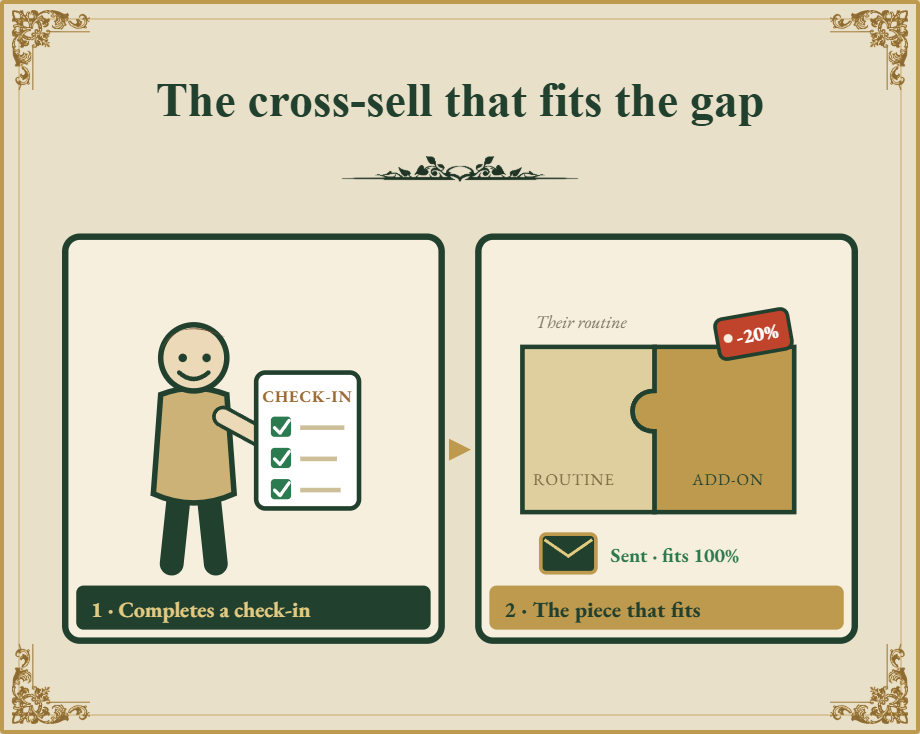
At the same time, a very valuable lever you can pull through the Check-In is to send the customer to complete a review on the brand's website.
Then, we create a separate Klaviyo flow that sends all of the 5-star website reviews to the brand's TrustPilot page.
The thing with TrustPilot reviews is that they cannot be changed, but it is not illegal to cherry pick the people that leave the review.
We've set up this system to take brands with TrustPilot scores as low as 2.2/5 stars, all the way to 4.8/5 in just a few months.
At the same time, you can also have a question where you ask the customers a question that segments them into potential buyers for another product of the brand.
For example, if you have a beauty brand and you're selling skin masks for the face, chest & neck, you can ask the customers which area of their skin they feel is the worst, and a few days later, according to their answers, we can send them a personalized cross-sell.
If they answered that their neck's skin feels the worst, we cross-sell them to the neck mask, while referencing their answer a few days prior. These cross-sells are going to perform much higher than ones that are sent out at random, because it shows that the brand cares about the customer as a person, by offering at a discount a product that is suited specifically to them.
This is a live example of how personalization results in a direct LTV boost.
On to the final stage of the post-purchase experience! We're almost there!
Stage three, Re-Purchase
Re-Purchase
It's during this phase where we can save the most churn & add the most LTV while making the smallest changes.
Re-Purchase, asset one · The big lever
The 3-Month Bundle
A few days after the check-in, you should organize a 5-day series of emails where you upsell customers to a pre-paid subscription with a 90-day cadence.
By now, the customer has been educated on how to use the product, and has most likely developed a habit, so they have enough knowledge to make such a decision. By then the habit is built & the full spectrum of benefits has landed.
But the deeper meaning of the 3-month bundle is about getting a customer past month 4. After that, churn flattens out.
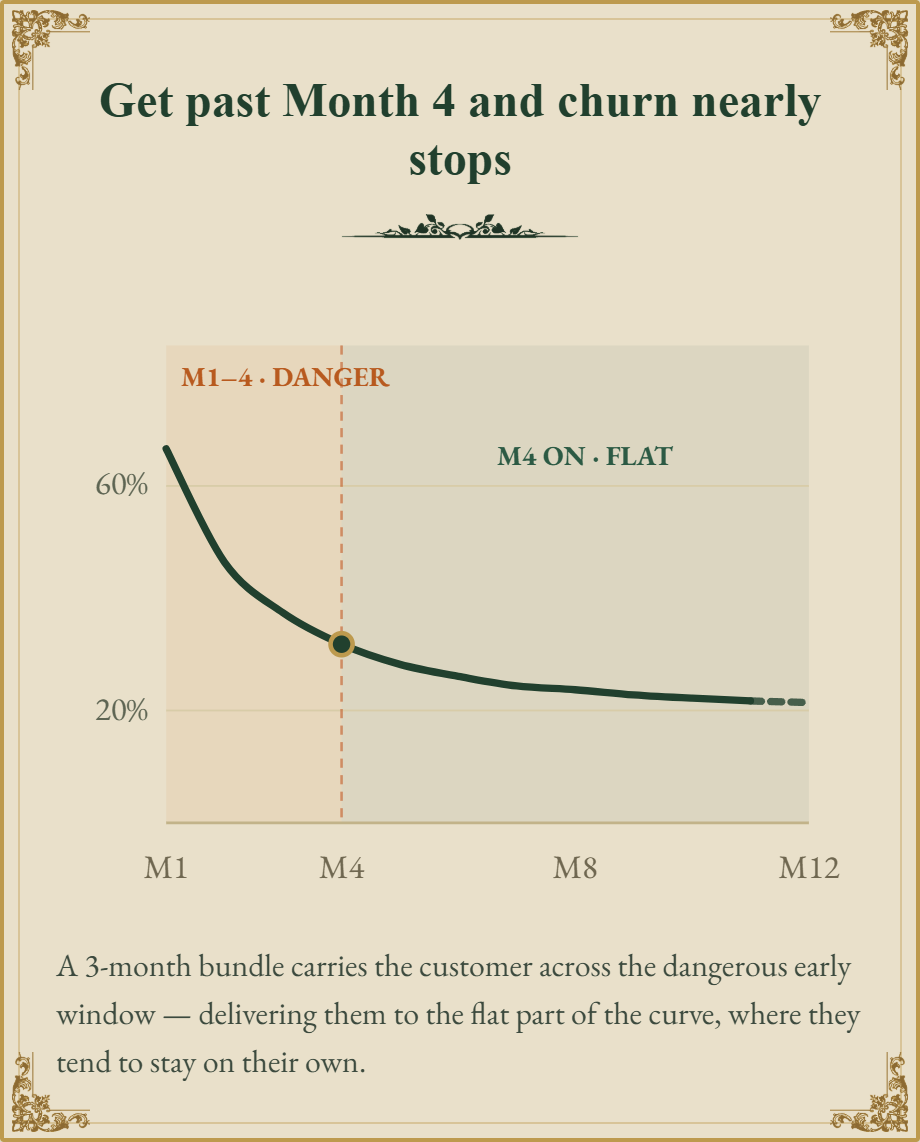
A 3-month bundle buys the customer safe passage through that dangerous churn window, and it serves as a cash-in point for potential loyalists.
Instead of asking them to re-decide every single month, right when churn is at its worst, you carry them across the gap in one move and deliver them to the other side of the Retention Curve.
So this is what I mean when I say that the bundle does 2 things at the same time:
- It lifts LTV directly
- It pulls three months of cash forward, which shortens your payback period
Also, since we're shipping out a lot of products at once, make sure to include a discount to incentivize the customer to purchase the bundle.
Re-Purchase, asset two · Transparency · The biggest mistake brands make
Billing Reminder
Congrats! We're in the final component of the post-purchase experience! You're almost there!
This is the smallest change you can make that allows you to rescue the most churn.
More than 80% of the brands that we work with do billing reminders wrong.
Sometimes, brands hide the billing reminder all together, and hope that the subscriber forgets and stays subscribed accidentally. This violates our principle of transparency extremely hard, so it's self-explanatory why going down that route won't help you build a sustainable brand long-term.
And even when the billing reminder is turned on, in most cases it's going to look like this:
"Hey, your subscription renews in 3 days, click here to manage your subscription."
This is the email that generates the most churn over the entire experience.
I mean, you're practically begging the subscriber to cancel. You're just reminding them that you're taking their money in 4 days' time, and now is the chance to save their money. (LOL)
The Pro way of creating a billing reminder, is to frame it around next month's freebie, while giving them the option to order now instead of waiting 3 days, adding a cross-sell at a discount before the order ships, adding more product at a discount, and then finally giving them the choice of managing their subscription.
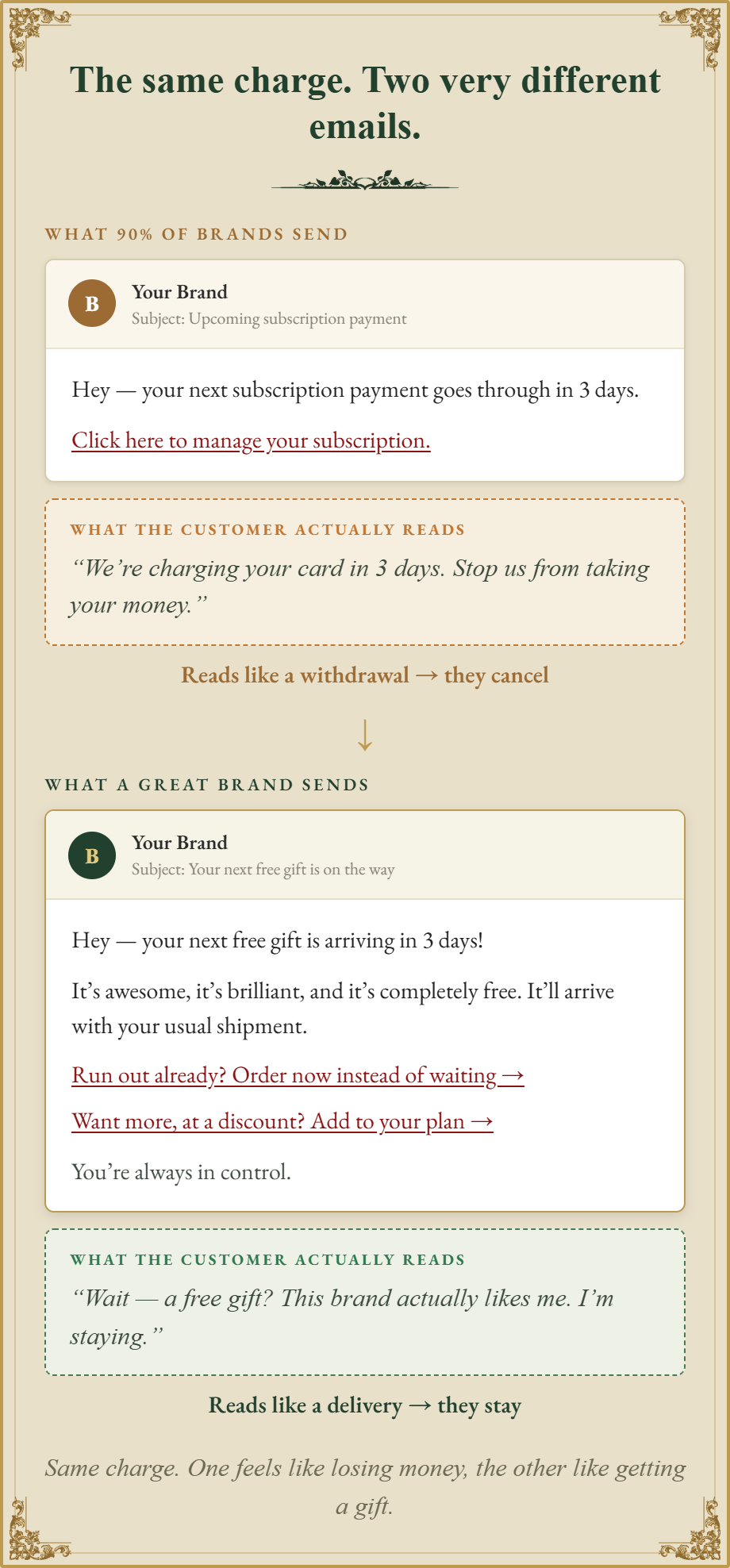
By using the framing of "Your gift arrives in 3 days" instead of "We're taking your money in 3 days", we show customers that we care about their wants & needs by telling them that if they cancel now, they have something to lose (their free gift).
At the same time, we still allow them to cancel their subscription if they want to (we're being transparent, as always, and also give them the chance to re-order earlier, if they've run out of product and want it to arrive earlier).
Making this tiny change in one email is going to save you countless churned subscribers.
The whole picture
That's The Entire Blueprint!
Congrats! You're better educated on retention than 99% of people out there!
You're equipped to save thousands of subscribers that are about to churn, and millions of dollars in recurring revenue, no matter how big or small your brand is. The best thing about these components and strategies, is the fact that they're universal. They still work, whether you're in the Pet Food space, the Supplement space, the Beauty space, or the Beverage space.
How deep it goes
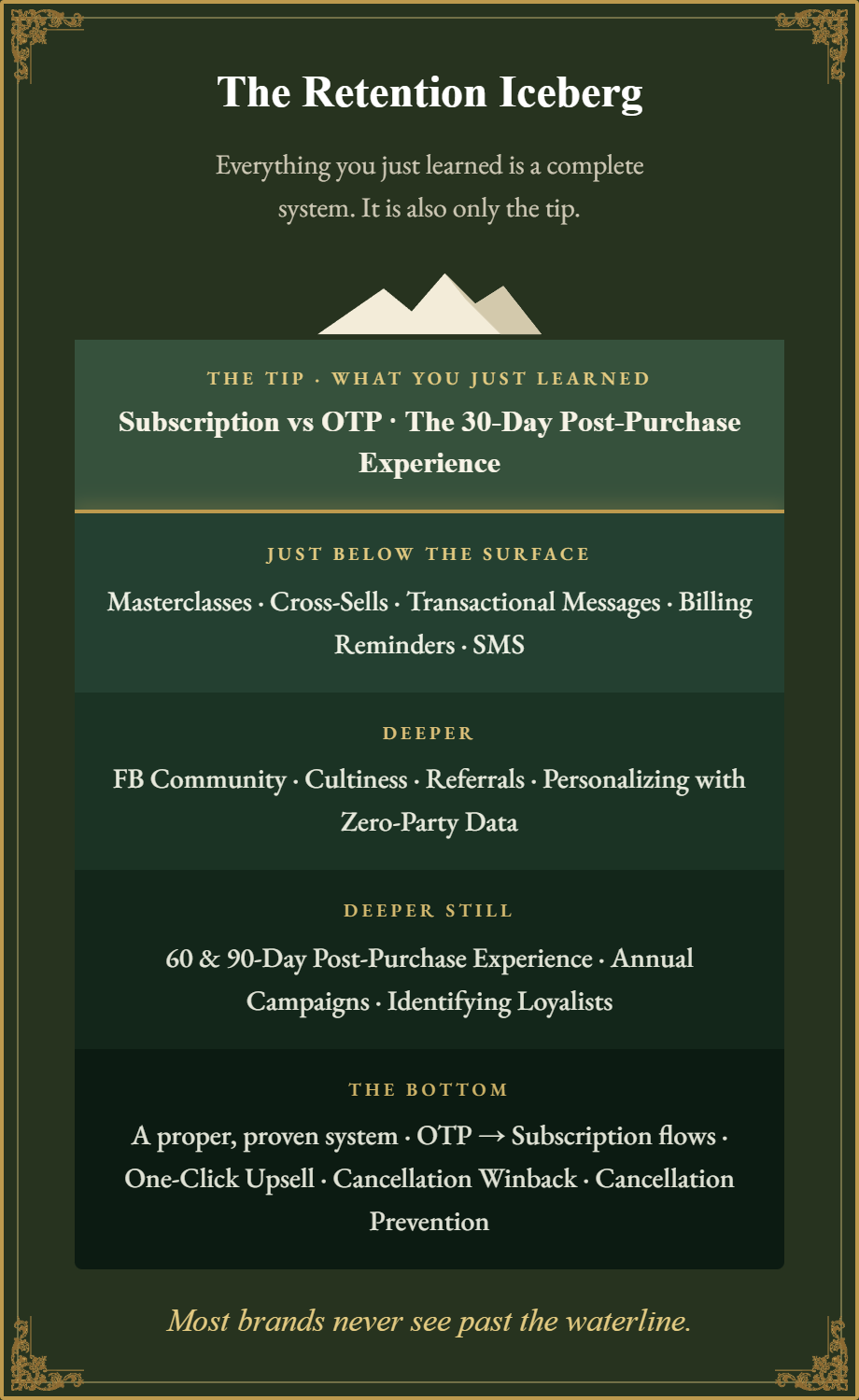
The Tip Of The Iceberg
Everything you just read is the blueprint for turning your brand into one that's optimized for subscription & recurring revenue.
But it's also important to say that it covers only certain sections of the Retention Iceberg. Most brands never actually see past the surface.
Knowing about all of these strategies and concepts is one thing, but applying them in practice is a whole different world.
The next step
Want The Full Blueprint?
So if you'd like us to walk you through the entire blueprint, with the AI prompts, a specific email and SMS sending timeline, and real examples from other 8 and 9-figure eCommerce brands, let's talk.
I hope that you found a lot of value inside this Playbook. Until next time!
Jimmy Dimitriou,
Retention Engineer at The Art of eComm